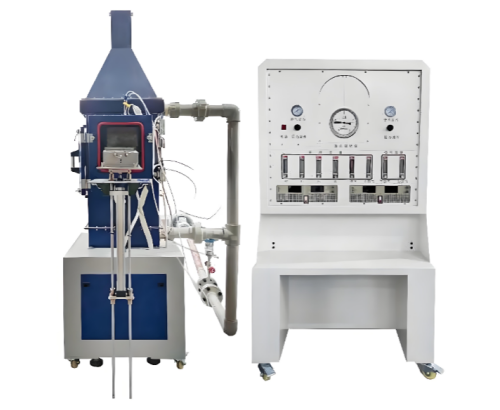
Photovoltaic Module Combustion Tester
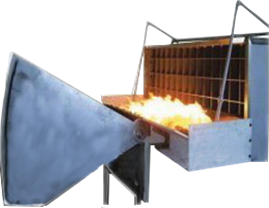


The Photovoltaic Module Combustion Tester is designed to simulate real-world conditions for evaluating the fire resistance performance of rooftops and photovoltaic (PV) modules. The system can assess sample ratings as Class A, B, or C under flame spread distances of 1.82m (A), 2.4m (B), and 3.9m (C), while also testing the flame-retardant properties of PV modules.
Applications
This tester is suitable for:
(1) Assessing fire resistance of roofing materials and rooftop structures.
(2) Testing flame-retardant performance of photovoltaic modules and components.
(3) Evaluating flame spread and burning behavior of materials exposed to controlled flame sources.
(4) Conducting standardized fire tests for building safety certification of roofs.
(5) Research and development in material fire resistance for residential, commercial, and renewable energy applications.
Standards
(1) UL 1730 – Standard for Smoke Detectors in Multi-Family Residences and Hotel Rooms
(2) UL 790 – Standard Test Methods for Fire Resistance of Roof Covering Materials
(3) IEC 61730-2 Annex A – Photovoltaic (PV) Module Fire Testing
(4) ASTM E108-04 – Standard Test Methods for Fire Tests of Roof Coverings
Product Features
(1) Cylinder mechanism for precise roof deck slope adjustment.
(2) Fireproof panels attached to the test deck for accurate evaluation.
(3) Automatic control valves to regulate flame temperature:
- Class A, B: 760 ±28℃ (1400 ±50℉), 21,000–22,000 Btu/min
- Class C: 704 ±28℃ (1300 ±50℉), 18,000–19,000 Btu/min
(4) Gas delivery follows strict control procedures:
- LNG: MFM ensures accurate flow measurement; automatically controlled valves
- LPG: Inverter system regulates air velocity; test deck air speed 19±8 km/h (5.5 m/s)
(5) Automatic ignition for precise and safe testing.
(6) Ventilation duct deflectors minimize airflow disturbance.
(7) Slope-adjustable panels to optimize air flow direction.
(8) Thermocouple installed 58.7mm above burner tip; measures temperature up to 888 ±28℃.
(9) DAQ system enables fully automated control and test execution.
Test Results
(1) Flame Spread Performance:
- Any part of the roof material, PV module, or panel may release flames or glowing particles.
- Fire safety Class A: flame spread 1.82 m
- Fire safety Class B: flame spread 2.4 m
- Fire safety Class C: flame spread 3.9 m
- Flame spread measured from the edge of the sample.
(2) Roof Combustion Performance:
- Panels or components may release flames or glowing particles from the deck.
- Certain areas of the roof deck or structure may expose components partially or fully during burning.
- The burning state of the component or panel is maintained for evaluation.
Technical Parameters
| Category | Parameter | Value / Range |
|---|---|---|
| Dimensions | Overall size (L × W × H) | 6000 × 2200 × 2000 mm |
| Power Supply | Voltage / Phase / Frequency | AC 380V, 3-Phase, 50/60 Hz |
| Current | 50A | |
| Weight | Instrument weight | Approx. 850 kg |
| Exhaust | Minimum exhaust volume | 400 m³/min |
| Fuel | Gas type | Propane / Liquefied Natural Gas (LNG) |
| Other Tools | Auxiliary equipment | Compressed gas, vacuum pump, computer interface |
FAQ
(1) What is this product?
The Photovoltaic Module Combustion Tester is a fire testing instrument designed to evaluate flame spread and burning behavior of rooftop materials and photovoltaic modules.
(2) What is this product used for?
It is used to determine the fire safety rating of roofing materials and PV modules, including flame-retardant performance and roof combustion behavior.
(3) Why is this product important?
The tester ensures roofing and PV module materials meet fire safety standards, protecting buildings, residents, and energy systems from fire hazards.
(4) What products can be tested with this instrument?
Roof coverings, rooftop structures, and photovoltaic modules or panels.
(5) What types or classes of fire testing does it perform?
It evaluates Class A, B, and C fire safety ratings under controlled flame spread conditions.
(6) How is the tester operated?
The system uses automatic ignition, DAQ control, and adjustable slope and gas flow to perform fire tests. Operators set the desired fire class and start the test via the control system, which automatically monitors temperature, flame spread, and combustion behavior.
Leave Message Get Price