Four-Point Probe Tester DIN EN ISO 3915
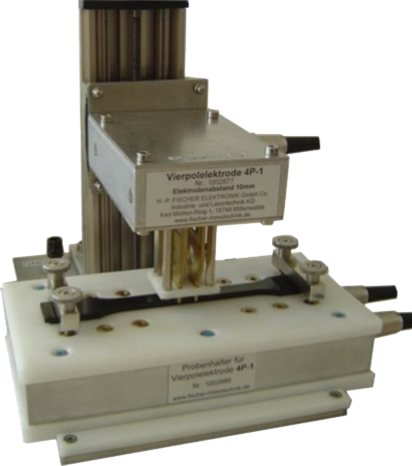


The Four-Point Probe Tester 4P-1 is designed for precise measurement of electrical resistance in conductive materials using the four-terminal (Kelvin) method. It ensures high accuracy in both low- and high-resistance ranges, supporting material testing, quality control, and research applications in electronics, conductive coatings, and materials science.
Applications
(1) Conductive materials testing – thin films, conductive polymers, and metallic coatings.
(2) Electronics manufacturing – printed circuit boards (PCBs), conductive adhesives, and component quality assessment.
(3) Research laboratories – characterization of nanomaterials, carbon-based conductors, and composite conductive materials.
(4) Industrial quality control – monitoring surface resistivity of electrostatic discharge (ESD) protection materials.
(5) Educational institutions – training and experiments in material science and electrical engineering.
Standards
(1) DIN EN ISO 3915 – Plastics – Measurement of specific volume resistivity and surface resistivity using the four-point method.
(2) IEC 61340-4-1 – Electrostatics – Materials for the control of electrostatic phenomena – Part 4-1: Resistance measurement.
(3) ASTM D257 – Standard Test Methods for DC Resistance or Conductance of Insulating Materials (complementary for surface resistivity).
Technical Parameters
| Parameter | Specification |
|---|---|
| Measurement method | Four-terminal (Kelvin) method |
| Probe contact spacing | 20 mm |
| Single probe contact length | 10 mm |
| Contact pressure | 0.6 N |
| Electrode spacing | 50 mm |
| Sample positioning | Horizontally movable, precise spindle drive |
| Sample connection | Supports Milli-TO 3 and TO 3 for low-resistance measurements; also compatible with megohmmeter for high-resistance testing |
| Sample size (W/D/H) | Minimum 70×10×1 mm; Maximum 150×20×20 mm |
| Measurement range | 100 mΩ – 180 kΩ |
| Material support | Conductive sheets, films, and coatings |
Advantages
(1) Four-terminal configuration eliminates contact resistance effects, ensuring high measurement accuracy.
(2) Movable sample stage allows multiple positions to be tested without repositioning probes.
(3) Supports both low-resistance and high-resistance measurements via Milli-TO 3, TO 3, or megohmmeter.
(4) Compact and durable design suitable for laboratory and industrial use.
(5) Easy-to-use probe structure for reliable, repeatable testing.
FAQ
(1) What is the instrument used for?
It measures the surface and volume resistance of conductive materials with high accuracy using the four-terminal method.
(2) What types of samples can it test?
Conductive thin films, polymer composites, metallic coatings, PCBs, and electrostatic discharge (ESD) protection materials.
(3) Which standards does it comply with?
DIN EN ISO 3915, IEC 61340-4-1, and ASTM D257 (for reference).
(4) How does it ensure accurate measurements?
The four-terminal configuration removes the influence of contact resistance, and the movable sample stage allows precise positioning for consistent readings.
Leave Message Get Price