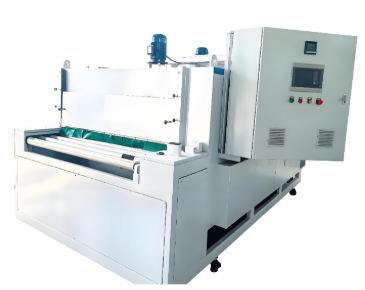
Thermal Conductivity tester Of High Temperature Materials



The High-Temperature Thermal Conductivity Tester for Refractory Materials is designed to measure the thermal conductivity of refractory insulation materials and ceramic fiber products at elevated temperatures. It is suitable for testing ceramic fiber blankets, felts, boards, and other compatible refractory materials. The instrument uses a water-flow plate method to determine thermal conductivity under controlled heating and water circulation conditions.
The tester features a high-temperature furnace, multiple thermocouples, a constant-pressure water circulation system, and computer-based temperature control and data acquisition. Its furnace can reach approximately 1200°C, while the measurement system covers a thermal conductivity range of 0.03–2.00 W/(m·K). It is suitable for refractory material manufacturers, quality inspection laboratories, universities, and research institutions.
Application
(1) Ceramic Fiber Blankets and Felts: Measurement of thermal conductivity to evaluate insulation performance at elevated temperatures.
(2) Ceramic Fiber Boards: Testing of compatible rigid or semi-rigid refractory fiber insulation products.
(3) Refractory Insulation Materials: Evaluation of thermal conductivity for materials used in industrial furnaces and thermal insulation systems.
(4) Refractory Bricks and Boards: Testing of compatible refractory specimens using the specified water-flow plate method.
(5) Industrial Thermal Insulation: Comparative evaluation of insulation materials intended for high-temperature equipment.
(6) Material Research and Development: Investigation of the thermal conductivity of refractory materials under different test conditions.
(7) Quality Control: Verification of material performance during production and laboratory inspection.
The applicable specimen dimensions, test temperature, heating conditions, and measurement procedure should be selected according to the relevant testing standard and material type.
Standards
(1) GB/T 17911-2018 — Methods of Test for Refractory Fibre Products. This Chinese national standard covers test methods for refractory fiber products, including relevant thermal conductivity testing. It replaced GB/T 17911-2006 and remains current.
(2) YB/T 4130-2005 — Refractory Materials — Determination of Thermal Conductivity by the Water-Flow Plate Method. This is the standard specified in the original product information and remains applicable until its replacement takes effect on November 1, 2026.
(3) YB/T 4130-2026 — Refractory Materials — Test Method for Thermal Conductivity (Water-Flow Plate Method). This revised industry standard was published on April 16, 2026, and is scheduled to take effect on November 1, 2026, replacing YB/T 4130-2005.
(4) ISO 10635:1999 — Refractory Products — Methods of Test for Ceramic Fibre Products. This international standard covers tests of ceramic fiber products, including thermal conductivity. ISO confirmed this edition as current in 2025.
Parameters
| Parameter | Specification |
|---|---|
| Product Name | High-Temperature Thermal Conductivity Tester for Refractory Materials |
| Testing Method | Water-flow plate method |
| Maximum Furnace Temperature | Approximately 1200°C |
| Thermal Conductivity Range | 0.03–2.00 W/(m·K) |
| Heating Elements | 9 silicon carbide rods |
| Temperature Monitoring | Furnace temperature, specimen center temperature, and specimen surface temperature |
| Thermocouple Scanning Device | Rotatable and height-adjustable, with 360° rotation as specified |
| Water Circulation System | Constant-pressure water tank with three flowmeters |
| Furnace Insulation | High-alumina fiber insulation |
| Temperature Control | Omron PLC with temperature expansion module |
| Switching Components | Schneider solid-state non-contact switching device |
| Data Acquisition Interface | RS-232 serial communication |
| Data Processing | Automatic data acquisition, curve display, historical data query, export, and printing |
| Typical Test Duration | Approximately 8–12 hours |
Features
(1) High-Temperature Testing: The furnace can reach approximately 1200°C, supporting thermal conductivity evaluation of compatible refractory materials.
(2) Wide Measurement Range: Measures thermal conductivity within the specified range of 0.03–2.00 W/(m·K).
(3) Multiple Temperature Monitoring Points: Thermocouples monitor furnace temperature, specimen center temperature, and specimen surface temperature.
(4) Uniform Heating Arrangement: Nine silicon carbide heating rods are evenly distributed within the furnace to support stable heating conditions.
(5) Constant-Pressure Water Circulation: The water tank and three flowmeters help regulate water circulation during testing.
(6) Improved Temperature Stability: A guarded calorimeter arrangement helps reduce unwanted heat exchange with the surroundings and improve specimen temperature stability.
(7) Lightweight Furnace Insulation: High-alumina fiber insulation reduces furnace weight compared with conventional refractory brick insulation.
(8) Multiple Specimen Layers: The furnace design supports placement of multiple specimen layers, subject to the applicable test configuration.
(9) Automatic Temperature Control: The Omron PLC and auxiliary temperature modules control the heating process and support stable equipment operation.
(10) Computer-Based Data Analysis: Software supports automatic data collection, test curve display, historical data query, result export, and report printing.
(11) RS-232 Data Interface: Provides serial communication for synchronized data acquisition and computer connection.
(12) Remote Technical Support: Internet-based remote support is available as described by the manufacturer, subject to the required network connection and service arrangements.
Leave Message Get Price