Humidified Tandem Differential Mobility Analyzer
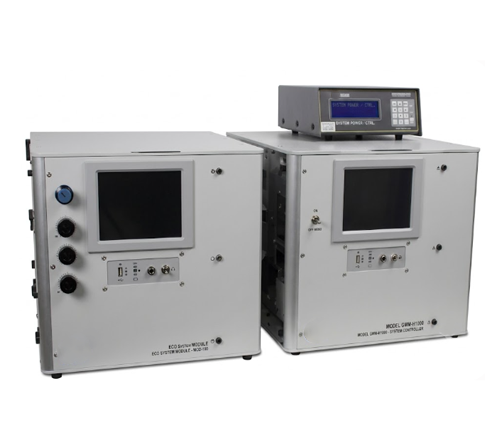


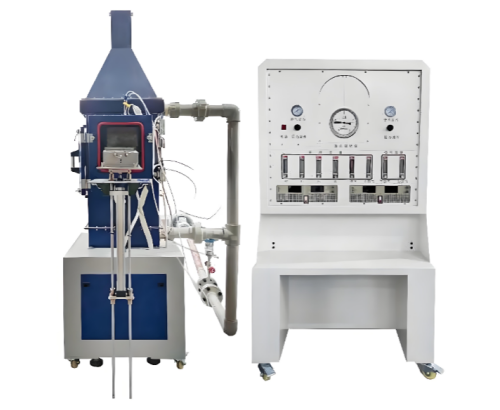
The Humidified Tandem Differential Mobility Analyzer (DMA) system has two differential mobility analyzers and a humidification section in between. Aerosol from the ambient atmosphere or from the built-in aerosol generator can be classified by the first DMA to produce a monodisperse aerosol for size analysis by the second DMA to determine the growth in particle size as a function of relative humidity
Application
· Study of the hygroscopic growth of aerosols for accurate deliquescence and efflorescence measurements.
· Other aerosol studies by the TDMA method.
Standards
(1) ISO 15900 — Determination of Particle Size Distribution — Differential Electrical Mobility Analysis for Aerosol Particles
(2) ISO 27891 — Aerosol Particle Number Concentration Calibration of Condensation Particle Counters
(3) ISO 15901 Series — Evaluation of Pore Size Distribution by Particle Measurement Methods
(4) WMO Aerosol Measurement Guidelines — World Meteorological Organization recommendations for atmospheric aerosol observation
(5) ACTRIS Aerosol Measurement Guidelines — European research infrastructure guidelines for aerosol characterization
Technical Parameters
| Overall Specifications of the Model 1040XP HTDMA* | |
| Aerosol Generator (Part 1 of system) | 460 mm (H) x 610 mm (D) x 525 mm (W) |
| Part 1/Part 2 Total Weight | 100 lbs (45 kg)/ 140 lbs (60 kg) |
| Power Requirements (Part 1) | 115 or 230 VAC, 50-60 Hz, single phase, 250 W max, 160 W steady |
| Humidity Conditioner/Spectrometer (Part 2) | 460 mm (H) x 610 mm (D) x 525 mm (W) |
| Power Requirements (Part 2) | 100- 240 VAC, 50-60 Hz, single phase, 500 W max, 400 W steady |
| Operating Aerosol Pressure | 800 to 1050 mbar absolute pressure |
| Ambient Temperature Range | 10 to 35 ºC |
| Ambient Humidity Range | 0-90% RH, non-condensing |
| Polydisperse Aerosol Generation System | |
| Single-Jet Atomizer | Stainless Steel Construction |
| Pressure | 5 to 60 psig (5 to 415 kPa gage), controlled by manual pressure regulator |
| Aerosol Flow Rate | Typical 3 L/min @ 35 psig (240 kPa gage) |
| Volume Mean Droplet Diameter | about 2 µm (GSD< 2.0) |
| Aerosol Size Range | 10 to 2000 nm |
| Aerosol Concentration | > 107 particles/cm3 (typical for NaCl) |
| Dryer | Diffusion type (NafionR membrane requires dry comp. air, -20 ºC dew point) |
| Humidity Conditioner | |
| Relative Humidity Control Range | 10 to 93% with user-selected set point in 1% intervals |
| Flow Rate | 1 to 10 L/min |
| RTD and Dew Point Accuracy | ± 0. 2 ºC |
| RH Accuracy | ± 1.5% for chilled mirror sensor; ± 2.5% for capacitive sensor |
| RH control stability | ± 1.2% (typical) |
| Response Time for < 10% ΔRH | < 3 min (typical) |
| Water Reservoir Heater Control | 25 to 50 ºC in 5 ºC intervals |
| Saturator | Nafion® Humidifier with DI water closed loop circulation |
| Dryer | Diffusion type (Drierite® desiccant) |
Structure
· Built-in Atomizer Aerosol Generator
· Electrical Ionizer
· Differential Mobility Analyzer (DMA)
· Electrical Mobility Spectrometer
· Condensation Particle Counter (CPC)
· Humidity Conditioner
· Data analysis software
Features
· High stability atomizer aerosol generator
· High accuracy aerosol humidity conditioner
· Wide range, high resolution DMAs
· Patented dual-reservoir CPCs
· DMS and SMS data analysis software
· User friendly user interface with touch screen display
· Automatic data logging
FAQ
(1) What information can an HTDMA system provide about aerosol particles?
The HTDMA system measures how aerosol particle size changes with relative humidity, allowing researchers to evaluate hygroscopic growth factors, water uptake behavior, and phase transition characteristics such as deliquescence and efflorescence.
(2) What types of aerosol samples can be analyzed with this system?
The system can analyze laboratory-generated and ambient aerosols, including inorganic salts, environmental particles, and nanoscale aerosol materials. The built-in atomizer generator supports controlled aerosol production for repeatable research experiments.
(3) Why is humidity control important in aerosol measurement?
Relative humidity significantly affects aerosol particle size, composition, and atmospheric behavior. Accurate humidity conditioning allows researchers to simulate environmental conditions and obtain reliable data on particle growth and water absorption characteristics.
(4) How does the system ensure measurement reliability?
Reliable results depend on stable aerosol generation, accurate humidity control, and proper instrument calibration. QINSUN instruments are calibrated and tested before shipment to ensure stable operation and reliable measurement performance.
(5) How can I select the suitable HTDMA configuration for my research project?
Configuration selection depends on aerosol type, particle size range, humidity requirements, and research objectives. QINSUN engineers can provide technical consultation, application guidance, and customized solutions based on laboratory requirements.
Leave Message Get Price