Vicat Softening Point Tester
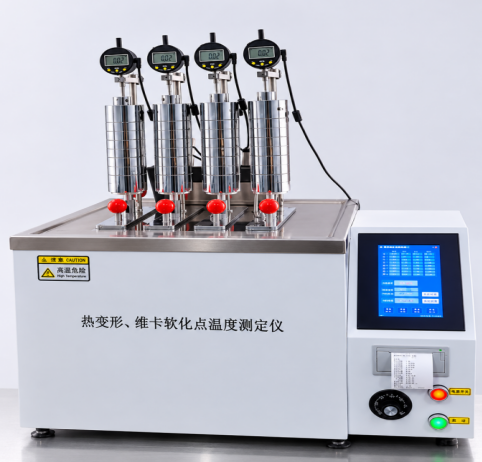


The Vicat Softening Point Tester is designed to determine the Vicat softening temperature (VST) and heat deflection temperature (HDT) of non-metallic materials, including plastics, hard rubber, nylon, electrical insulation materials, long-fiber-reinforced composites, and high-strength thermosetting laminates.
The instrument uses a temperature-controlled heating system and precision displacement measurement to evaluate the thermal deformation characteristics of specimens under specified loads. It supports both Vicat softening and heat deflection testing through interchangeable Vicat penetration needles and HDT indenters.
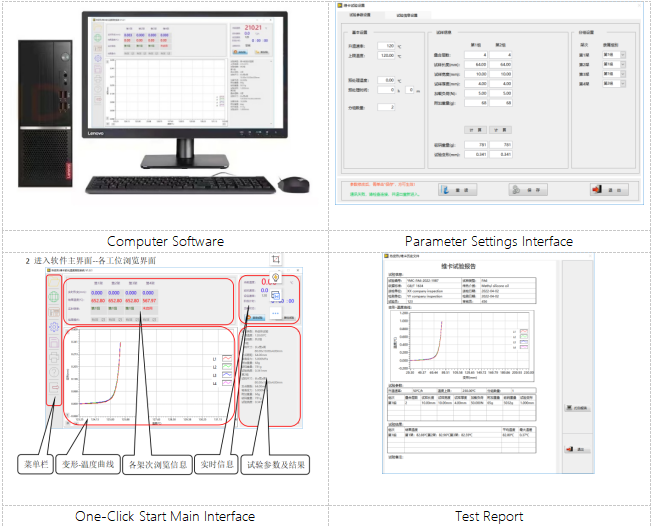
Equipped with a self-developed ARM control system, a 7-inch touchscreen, and dedicated computer software, the tester supports four simultaneous test stations. Temperature-displacement curves can be displayed in real time, while test data can be analyzed, stored, and printed.
Its advanced PID temperature control, high-precision sensors, and multiple safety protection mechanisms make it suitable for plastic manufacturers, material research laboratories, universities, and quality inspection organizations.
Application
(1) Thermoplastic materials and engineering plastics.
(2) Hard rubber and elastomeric materials.
(3) Nylon and fiber-reinforced plastics.
(4) Electrical insulation materials.
(5) Long-fiber-reinforced composite materials.
(6) High-strength thermosetting laminated materials.
(7) Heat deflection temperature and Vicat softening temperature evaluation.
(8) Polymer material research, product development, and quality control.
Standards
GB/T 1633-2025 — Plastics — Thermoplastic Materials — Determination of Vicat Softening Temperature (VST)
GB/T 8802-2001 — Thermoplastics Pipes and Fittings — Determination of Vicat Softening Temperature
GB/T 1634.1-2025 — Plastics — Determination of Temperature of Deflection Under Load — Part 1: General Test Method
GB/T 1634.2-2019 — Plastics — Determination of Temperature of Deflection Under Load — Part 2: Plastics and Ebonite
GB/T 1634.3-2004 — Plastics — Determination of Temperature of Deflection Under Load — Part 3: High-Strength Thermosetting Laminates
ISO 306:2022 — Plastics — Thermoplastic Materials — Determination of Vicat Softening Temperature (VST)
ISO 2507:2026 — Thermoplastics Pipes and Fittings — Vicat Softening Temperature — General Test Method and Test Conditions for Vinyl Chloride-Based and Acrylonitrile-Based Pipes and Fittings
ISO 75-1:2020 — Plastics — Determination of Temperature of Deflection Under Load — Part 1: General Test Method
ISO 75-2:2013 — Plastics — Determination of Temperature of Deflection Under Load — Part 2: Plastics and Ebonite
ISO 75-3:2025 — Plastics — Determination of Temperature of Deflection Under Load — Part 3: High-Strength Thermosetting Laminates and Long-Fibre-Reinforced Plastics
ASTM D1525-25 — Standard Test Method for Vicat Softening Temperature of Plastics
ASTM D648-18 — Standard Test Method for Deflection Temperature of Plastics Under Flexural Load in the Edgewise Position
Parameters
| Parameter | Specification |
|---|---|
| Temperature control range | Room temperature to 300°C |
| Maximum temperature error | ±0.5°C |
| Heating rate | 50°C/h, 120°C/h, or adjustable between 50°C/h and 120°C/h |
| Temperature measurement points | 1 |
| Number of test stations | 4 |
| Deformation measurement range | 0–10 mm |
| Maximum deformation error | ±0.005 mm |
| Deformation resolution | 0.001 mm |
| Specimen support span | 64 mm and 100 mm |
| Heating power | 4,000 W |
| Temperature protection | Mechanical and software upper-temperature-limit protection |
| Control system | Self-developed ARM controller |
| Operating interface | 7-inch touchscreen and PC software |
| Operating medium | Methyl silicone oil or transformer oil, supplied by the user |
| Cooling method | Natural cooling above 150°C; water cooling or natural cooling below 150°C |
| Safety functions | Automatic shutdown, temperature-limit protection, and administrator password protection |
Features
(1) Dual Test Functions: Supports both Vicat softening temperature and heat deflection temperature testing with interchangeable test components.
(2) Four Test Stations: Allows four specimens to be tested simultaneously, improving laboratory testing efficiency.
(3) Advanced Control System: Uses a self-developed ARM controller combined with a 7-inch touchscreen and dedicated computer software.
(4) Real-Time Data Monitoring: Displays temperature-displacement curves and test results in real time.
(5) High-Precision Measurement: Uses high-performance temperature sensors and capacitive-grating digital displacement indicators.
(6) Advanced Temperature Control: Employs PID temperature control and optically isolated PWM heating output for stable temperature regulation.
(7) Multiple Heating Rates: Supports 50°C/h, 120°C/h, and adjustable heating rates between these values.
(8) Wide Temperature Range: Supports testing from room temperature to 300°C.
(9) Four-Level Safety Protection: Includes mechanical temperature-limit protection, software temperature-limit protection, automatic shutdown after testing, and administrator password protection.
(10) High-Power Heating System: Equipped with a 4,000 W heating system to support temperature increases up to 300°C at the specified heating rates.
(11) Computer-Based Analysis: Supports test data processing, temperature-displacement curve analysis, and report generation.
(12) Printing Function: Allows test curves, measurement data, and test reports to be printed through the software system.
Accessories
Standard Configuration
| Accessory | Quantity |
|---|---|
| Main unit | 1 unit |
| Specimen holders | 4 pcs |
| Heat deflection indenters | 4 pcs |
| Vicat penetration needles | 4 pcs |
| Testing software | 1 set |
| Power cable | 1 pc |
| Signal communication cable | 1 pc |
| Weight set | 1 set |
| Digital remote-reading dial indicators (0–10 mm) | 4 pcs |
Maintenance Information
(1) Heating System: Inspect the heating elements and electrical connections regularly. Ensure that the heating system can achieve and maintain the required temperature.
(2) Temperature Sensors: Check the temperature sensors periodically and verify their accuracy using suitable reference equipment.
(3) Displacement Indicators: Inspect the four digital indicators for correct positioning, stable readings, and repeatability. Verify their measurement accuracy regularly.
(4) Test Indenters and Needles: Keep the HDT indenters and Vicat penetration needles clean. Check for wear, deformation, or damage that could affect specimen contact.
(5) Specimen Holders: Inspect the four specimen holders for alignment and damage. Ensure that specimens are positioned securely and consistently.
(6) Operating Medium: Maintain the methyl silicone oil or transformer oil at the required level and replace contaminated or deteriorated medium according to the manufacturer's instructions.
(7) Temperature Control: Verify PID temperature control, heating rates, and upper-temperature-limit protection periodically.
(8) Cooling System: Check water connections when water cooling is used. Ensure that the cooling arrangement operates correctly according to the prescribed procedure.
(9) Software and Data: Check computer communication, real-time curve display, data storage, analysis, and printing functions regularly.
(10) Safety System: Periodically verify the mechanical temperature-limit switch, software protection, automatic shutdown, and administrator access control.
Leave Message Get Price