Double-Head Taber Abrasion Tester
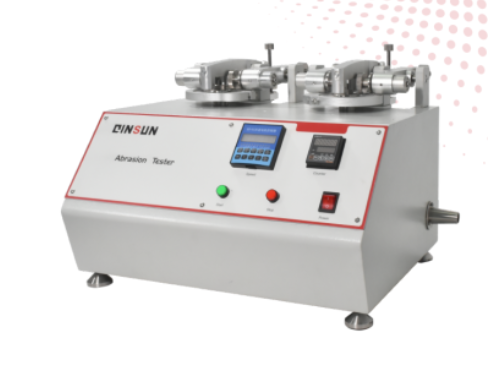


Taber abrasion tester is used to assess the wear resistance, such as measuring its quality loss, loss of thickness and light transmittance. Make the test piece by the standard cutter. Used the prescribed grinding wheel with a certain weight to wear. Remove the specimen after the specified rotation number, observe the weight difference before and after the test.
Application
Mainly used for the wear tests of suitcases, carpets, cardboard, clothing, glass, plastic coating, tiles, metal coating, paint, varnish, decorative flakes, high pressure sheet, plastic, textiles, flexible floor mats, traffic paint, anodized, electronic components, decorative panels, wax, labels, leather, dental materials, automotive interior ornaments, resins, furniture and so on.
Standards
1. DIN 53754 Testing of plastics; determination of abrasion, abrasive disk method
2. DIN 53109 Testing of paper and board; determination of abrasion by the abrasion wheel method
3. DIN 52347 Testing of glass and plastics; abrasion test; method using abrasion wheels and measurement of scattered light
4. TAPPI T476 Abrasion loss of paper and paperboard (Taber-type method)
5. ASTM D1044 Standard Test Method for Resistance of Transparent Plastics to Surface Abrasion
6. ASTM D3884 Standard guide for abrasion resistance of textile fabrics (Rotary platform, double-head method)
7. ISO-5470 Rubber- or plastics-coated fabrics - Determination of abrasion resistance
Technical Parameters
| Items | Parameters |
| Rotation speed | 30-75r/min adjustable(digital display) |
| Diameter of sample surface | 100mm |
| Diameter of test platform | 113mm |
| Set range of cylinder number | 1-999999 |
| Pressure of empty arm | 250g |
| Weights(according to customers) | 250g, 500g, 750g, 1000g |
| Pressure range of double wheels | 125g, 250g, 500g, 750g, 1000g, 1250g, et al. |
| Height of vacuum arm | Adjustable |
| Power | 220V, 50Hz |
| Dimension | 220mm×380mm×300mm |
| Weight | 20kg |
FAQ
(1) What materials can be tested with a Taber Abrasion Tester?
The instrument is suitable for a wide range of materials, including plastics, coatings, textiles, leather, paper, glass, flooring materials, and automotive interior components. The appropriate abrasive wheel and load can be selected according to the material type and applicable testing standard.
(2) What is the difference between single-head and double-head abrasion testing?
A double-head Taber Abrasion Tester uses two abrasive wheels to contact the sample simultaneously, improving testing efficiency and providing more uniform wear evaluation. It is commonly selected for laboratories requiring higher testing throughput and repeatability.
(3) Which standards can be used for abrasion resistance evaluation?
The tester supports commonly used abrasion standards including ASTM D1044 for transparent plastics, ASTM D3884 for textiles, ISO 5470 for coated fabrics, and TAPPI T476 for paper materials, depending on the tested product and evaluation method.
(4) How can test result accuracy be maintained during operation?
Reliable results require proper sample preparation, suitable abrasive wheel selection, and regular instrument verification. QINSUN instruments are calibrated and tested before shipment to ensure stable operation and accurate measurement performance.
(5) How should I select the correct configuration for my abrasion testing requirements?
Configuration selection depends on material type, required standard, loading force, and evaluation method, such as weight loss or appearance change analysis. QINSUN engineers can provide professional selection guidance, application solutions, and customized recommendations according to your testing needs.
Leave Message Get Price