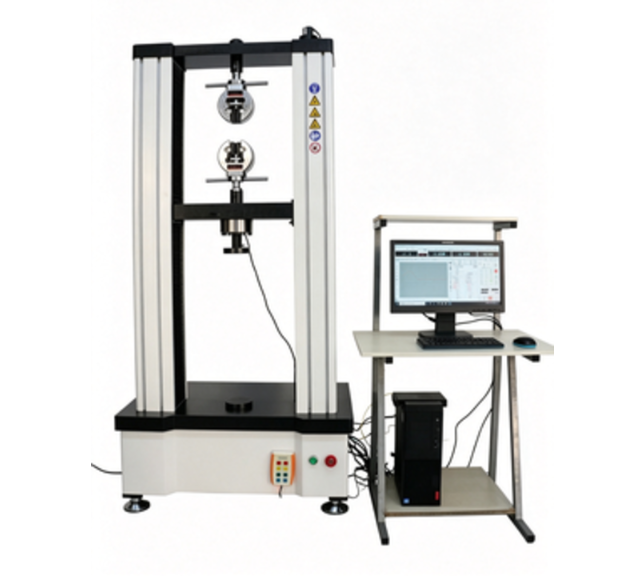
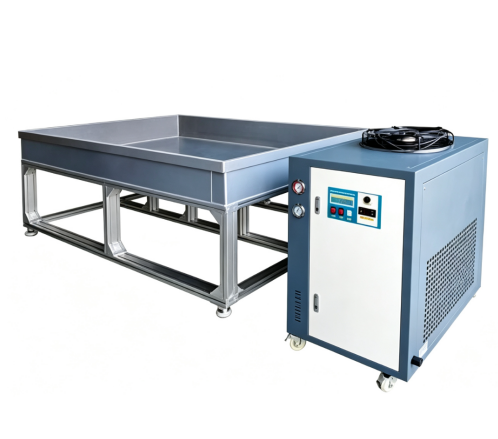
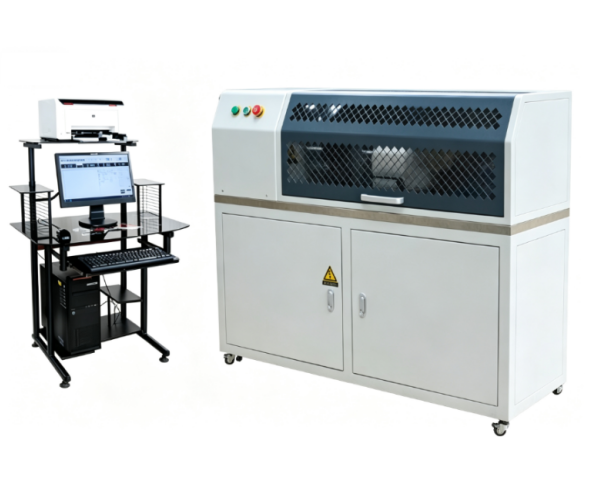
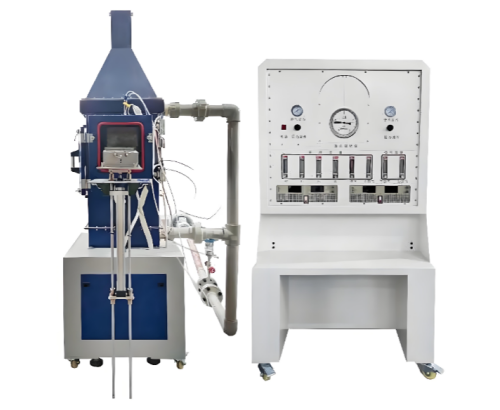
Tensile Testing Machine
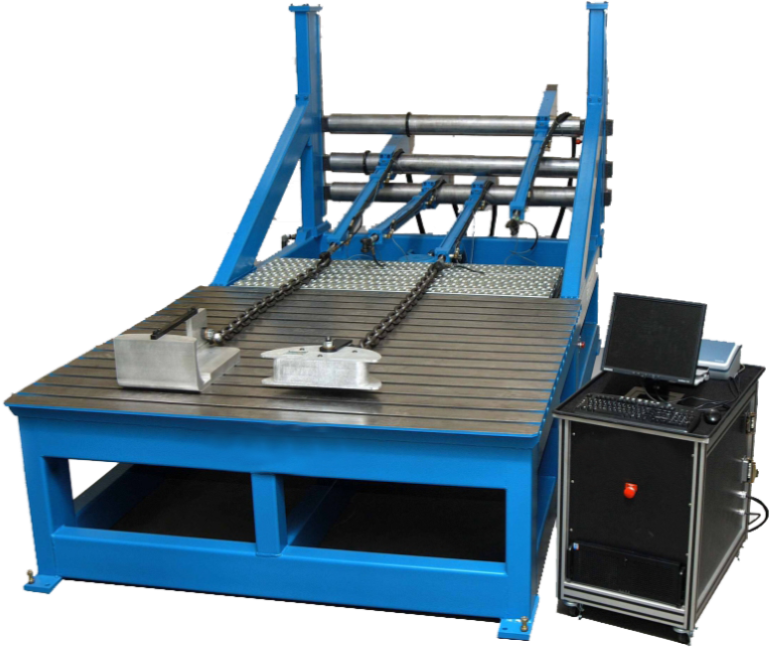


The Tensile Testing Machine is a heavy-duty hydraulic testing system designed for static tensile load evaluation of automotive seats, seat components, and restraint anchorage systems. The main mechanical structure is built on a 1-inch-thick ground steel floor plate. The working table height is adjustable, and the tensile surface is equipped with either a T-slot connection system or a 4-inch grid of thirteen threaded mounting holes to support flexible specimen fixation.
Additional internal steel reinforcements beneath the working surface minimize frame deflection during high-load testing. The hydraulic system is installed beneath the table, leaving sufficient space for fixture storage. Cylinders are mounted on transverse beams and can be manually repositioned laterally. Each beam is independently height-adjustable via dedicated lifting handles.
All cylinders are trunnion-mounted and balanced through a central stroke rod and load cell assembly. For seat belt tensile testing, optional universal joints can be added to allow rotation across two axes.
Application
The Tensile Testing Machine is used for static tensile strength and load-holding performance testing of the following products:
(1) Automotive seats and seat frames
(2) Seat mounting brackets and seat tracks
(3) Seat belt assemblies and anchorage points
(4) Child restraint anchorage systems (ISOFIX/LATCH)
(5) Automotive interior structural components
The large specimen installation area supports integration with a three-station automatic seat test bench, enabling simultaneous multi-point testing in automotive safety laboratories and manufacturing facilities.
Standards
The Tensile Testing Machine is designed in accordance with the following international standards and regulatory requirements:
(1) FMVSS 207 – Seating Systems
(2) FMVSS 210 – Seat Belt Assembly Anchorages
(3) FMVSS 225 – Child Restraint Anchorage Systems
(4) ISO 10542 – Wheelchair Tie-Down and Occupant Restraint Systems
(5) SAE J879 – Motor Vehicle Seat Systems
(6) GB 15083 – Motor Vehicle Seats, Seat Anchorages, and Head Restraints
(7) ECE R14 – Safety Belt Anchorages
(8) ECE R17 – Seats, Their Anchorages, and Head Restraints
Technical Parameters
| Item | Specification |
|---|---|
| Total machine weight | 26,400 lbs / 12,000 kg |
| Overall dimensions | 10 ft × 28 ft × 13 ft |
| Number of test stations | 9 |
| Single cylinder capacity | 10,000 lbs |
| Drive system | Hydraulic |
| Control mode | PC-based programmable control |
| Load measurement | Load cell with digital acquisition |
| Displacement measurement | Computer-controlled |
| Mounting surface | T-slot or threaded hole matrix |
| Power supply | As specified at order |
Features
(1) Heavy-duty steel floor plate with reinforced internal structure to reduce deflection.
(2) Large-area specimen mounting surface supporting multi-station configurations.
(3) Hydraulic drive system with high single-cylinder load capacity.
(4) PC-based automated operation with fully programmable test profiles.
(5) Automatic acquisition and generation of load and displacement data.
(6) Independent height adjustment for each transverse beam.
(7) Trunnion-mounted cylinders with balanced load sensor integration.
(8) Optional universal joint configuration for seat belt tensile testing.
(9) Color inkjet printer for graphical test data output.
(10) Structural components manufactured from aluminum and stainless steel.
Product Classification
(1) Single-Cylinder Static Load Testing Machine
Used for component-level tensile testing. Includes an independent floor-standing PC control and data acquisition system. Integrated or separate hydraulic power units are available. Non-hydraulic configurations can also be provided.
(2) Multi-Cylinder Static Load Testing Machine
Available with 1 to 12 cylinders, each rated up to 10,000 lbs (4,536 kg). Includes independent PC-based control and data acquisition. Integrated or separate hydraulic power units are optional.
(3) Hydraulic Continuous Fatigue and Static Load Testing Machine
Equipped with dual-piston cyclic loading capability and fully programmable load profiles. Can also be used as a tensile testing machine. Maximum load up to 7,500 lbs (≈3,400 kg) in any direction using 1,800 PSI hydraulic pressure.
Accessories
(1) Hydraulic power unit
(2) Load cells for each test cylinder
(3) PC control and data acquisition system
(4) Test fixture mounting hardware
(5) Inkjet printer
(6) Operation and maintenance manual
Test Procedures
(1) Secure the test specimen onto the mounting surface using appropriate fixtures.
(2) Adjust the transverse beam height and cylinder position to align with loading points.
(3) Zero and calibrate the load cell through the PC control system.
(4) Program the required static load and holding time.
(5) Initiate the test and apply load gradually.
(6) Record load and displacement data automatically.
(7) Release the load upon test completion and inspect specimen condition.
Maintenance Information
(1) Inspect hydraulic hoses and fittings regularly.
(2) Replace hydraulic oil and filters according to maintenance schedule.
(3) Verify load cell calibration periodically.
(4) Keep sliding beams and guide surfaces clean and lubricated.
(5) Disconnect power supply when the machine is not in operation.
FAQ
1. What is this machine used for?
It is used for static tensile strength testing of automotive seats, seat components, and restraint anchorage systems.
2. Can multiple tests be performed simultaneously?
Yes. The system supports up to nine test stations and can be expanded to multi-cylinder configurations.
3. Is the system programmable?
Yes. All test parameters are programmable via PC-based control software.
4. Can it perform seat belt anchorage tests?
Yes. With optional universal joints, the system supports seat belt tensile testing per FMVSS and ECE standards.
5. Is customization available?
Yes. Cylinder quantity, power unit configuration, mounting surface, and control options can be customized.
Leave Message Get Price