Ventilation Aging Test Chamber
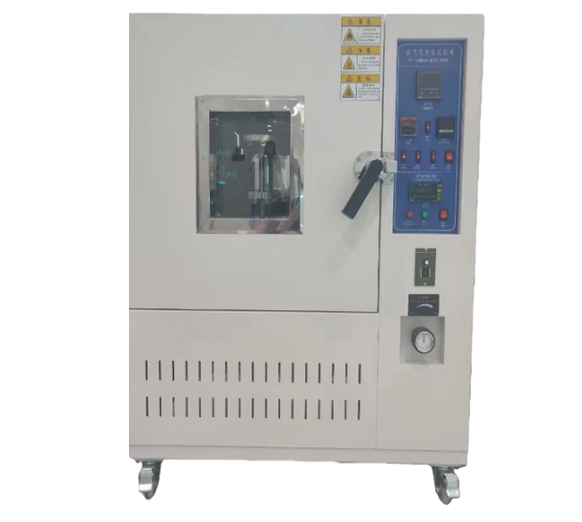


The Ventilation Aging Test Chamber is designed for accelerated aging evaluation of wires, leather, plastics, rubber, and fabrics. By maintaining fresh air circulation while uniformly heating specimens at controlled temperatures and durations, the chamber enables observation of pre- and post-aging performance—including yellowing resistance, delamination, shrinkage, elongation, and retention rate. For wire and cable testing, the chamber features a specialized ventilation volume adjustment to ensure continuous fresh air during thermal exposure.
Application
The chamber is suitable for testing and evaluating the aging characteristics of various materials and products, including:
(1) Electrical wires and cables (PVC, XLPE, or rubber-insulated cables)
(2) Leather products (footwear, upholstery, garments)
(3) Plastics and polymer components (automotive, electronics, packaging)
(4) Rubber materials (seals, hoses, gaskets)
(5) Fabrics and textiles (protective clothing, industrial fabrics)
(6) Quality control and R&D in manufacturing and material development
Standards
This instrument is designed in compliance with the following international standards:
(1) UL 1581 – Electrical Wires and Cables
(2) ASTM D2436 – Accelerated Aging of Insulated Wire and Cable
(3) CNS 3556 – Plastic Materials Thermal Aging
(4) CNS 742 – Rubber Materials Test Methods
(5) JIS K 7212 – Wire and Cable Thermal Aging Test
(6) JIS B 7757 – Plastic and Rubber Material Aging
(7) CE Certification (Conformité Européenne)
Features
Wide Temperature Range: Ambient +25°C up to 300°C for versatile aging tests.
Precise Control: ±0.5°C temperature accuracy with 0.1°C resolution.
Uniform Heating: ±2.5°C temperature uniformity ensures consistent results.
Adjustable Ventilation: Air exchange rate adjustable from 3 to 200 times per hour (RT–250°C), maintaining specimen freshness.
Rotating Tray: Detachable tray with 8–10 rpm rotation ensures uniform exposure.
User-Friendly Observation: Multi-layer vacuum glass observation window and wide-angle lighting for clear inspection.
Safety Features: Fuse protection, overload protection, and indicator lamps for operational status.
Durable Construction: SUS#304 stainless steel inner chamber with high-density rock wool insulation; off-white baked paint exterior.
Parameters
| Parameter | Specification |
|---|---|
| Inner Chamber Dimensions | 500 × 450 × 500 mm (W × D × H) |
| Outer Chamber Dimensions | 1,100 × 685 × 1,320 mm (W × D × H, approx.) |
| Power Supply | AC 380V, three-phase, 50 Hz |
| Power Consumption | 8 kW |
| Temperature Range | Ambient +25°C to 300°C |
| Control Accuracy | ±0.5°C |
| Temperature Resolution | 0.1°C |
| Temperature Uniformity | ±2.5°C |
| Heating Time | Ambient to 250°C ≈ 60 minutes |
| Rotating Tray Speed | 8–10 rpm |
| Ventilation Rate Adjustment | 3–200 times/hour (RT–250°C, measured at 80°C) |
| Observation Window | Multi-layer vacuum glass |
| Storage Racks | 2 racks |
| Additional Measurement Device | Taiwan TAIK original watt-hour meter |
Accessories
(1) Fuse protection switch and overload protection
(2) Indicator lamps for various operating statuses
(3) One detachable rotating tray with motor (8–10 rpm)
(4) Air exchange rate measurement device with digital wattmeter and timer (per JIS K7212)
(5) Ventilation volume adjustment device
(6) Wide-angle projection lighting
(7) Timer for aging and ventilation measurement
(8) Two test chamber storage racks
(9) Documentation and user guide
Test Procedures
Place test specimens on the rotating tray and adjust ventilation settings according to the material type.
Set the desired temperature and aging duration using the control panel.
Initiate the test cycle and monitor via the multi-layer glass observation window.
Record temperature, ventilation rate, and specimen condition at pre-defined intervals.
Upon completion, allow the chamber to cool and remove specimens for post-aging analysis.
Repeat test cycles for additional specimens as required.
Maintenance Information
Regularly inspect the inner chamber, heating elements, and rotating tray for wear or damage.
Verify calibration of thermometers, watt-hour meters, and airflow devices every six months.
Clean the interior chamber and ventilation ducts to prevent residue accumulation.
Ensure proper water and air supply for ventilation system operation.
Store the chamber in a dry, ventilated environment to prevent corrosion.
Leave Message Get Price