Submicron Aerosol Filter Efficiency Tester
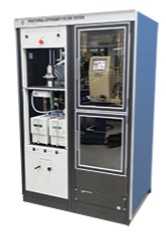


The Submicron Aerosol Filter Efficiency Tester is designed to evaluate the fractional filtration efficiency of high-efficiency particulate air (HEPA) filters, ultra-low penetration air (ULPA) filters, and flat-sheet filter media. It measures particle penetration at different particle sizes to determine the most penetrating particle size (MPPS) and characterize filter performance.
The system generates monodisperse aerosol particles using an atomizer bank and an electrostatic classification system. Two condensation particle counters simultaneously measure upstream and downstream particle concentrations, allowing the software to calculate penetration and filtration efficiency at each particle size.
The tester can evaluate particle sizes from 15 to 800 nm and test up to 20 selected particle sizes in a sequence. It generates penetration-versus-particle-size curves and summarizes results, including MPPS. Automated testing, computer-based analysis, and data export support filter development, laboratory research, and production quality control.
Application
(1) HEPA and ULPA filter media.
(2) High-efficiency air filter elements.
(3) Flat-sheet filtration media and membrane materials.
(4) Air filtration materials for cleanrooms and controlled environments.
(5) Filter media used in pharmaceutical, medical, laboratory, and industrial applications.
(6) Filter material development, fractional efficiency analysis, and quality control.
Standards
ISO 29463-1:2024 — High efficiency filters and filter media for removing particles in air — Part 1: Classification, performance, testing and marking
ISO 29463-3:2011 — High-efficiency filters and filter media for removing particles in air — Part 3: Testing flat sheet filter media
ISO 29463-5:2022 — High-efficiency filters and filter media for removing particles in air — Part 5: Test method for filter elements
Parameters
| Parameter | Specification |
|---|---|
| Aerosol particle size range | 0.015–0.800 μm (15–800 nm) |
| Number of selected particle sizes | Up to 20 per test sequence |
| Geometric standard deviation | <1.3 |
| Aerosol types | Sodium chloride (NaCl), DOP, and other oils |
| Aerosol detection method | Condensation particle counter (CPC) |
| Particle concentration dynamic range | <0.01 to 10⁶ particles/cm³ |
| Aerosol flow measurement | Thermal mass flowmeter |
| Adjustable aerosol flow range | 5–100 L/min |
| Aerosol flow accuracy | ±2% of reading |
| Pressure measurement method | Electronic pressure transducer |
| Pressure measurement range | 0–150 mmH₂O (0–1,470 Pa) |
| Pressure measurement accuracy | ±2% of full scale |
| Minimum measurable penetration | 0.000001% |
| Maximum stated filtration efficiency | 99.999999% |
| Data processing | Automated analysis, graphical and tabular reports |
| Data export | Microsoft Access database and Microsoft Excel |
| Internal pump | Built in |
| Power supply | 115 V AC, 60 Hz, 10 A, or 230 V AC, 50 Hz, 5 A |
| Compressed-air requirement | 7 m³/h at 415 kPa (4 SCFM at 60 psi) |
| Dimensions (H × W × D) | 183 × 122 × 82 cm |
| Weight | Approximately 410 kg |
Features
(1) Measures fractional filtration efficiency at different aerosol particle sizes.
(2) Determines the most penetrating particle size (MPPS).
(3) Covers a particle size range of 15–800 nm.
(4) Uses two condensation particle counters to measure upstream and downstream particle concentrations simultaneously.
(5) Calculates penetration and filtration efficiency automatically.
(6) Tests up to 20 selected monodisperse particle sizes in sequence.
(7) Generates penetration-versus-particle-size curves and summary reports.
(8) Supports filtration efficiency measurements up to 99.999999%, subject to the specified operating conditions and measurement limitations.
(9) Provides adjustable aerosol flow from 5 to 100 L/min.
(10) Includes software for automated test control, data analysis, reporting, and data export.
Leave Message Get Price