Liquid-Liquid Porosimeter
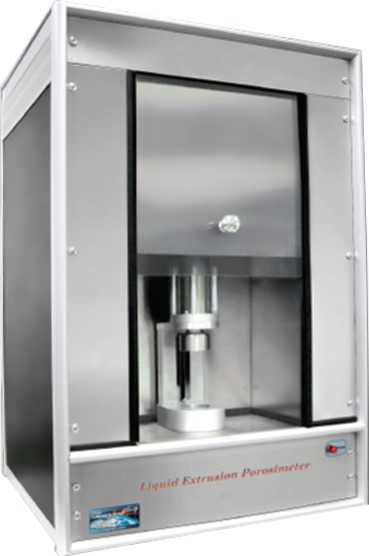


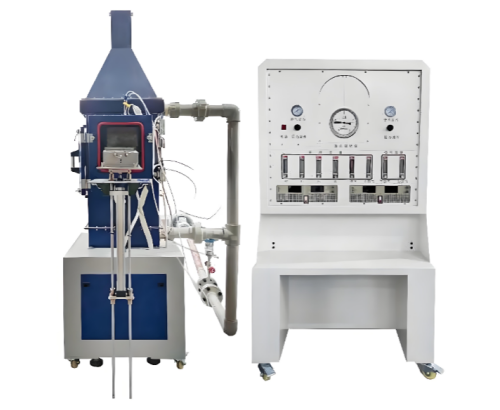
The liquid-liquid porosimeter is a unique instrument with the ability to measure through–pore volume, volume distribution and liquid permeability without using mercury. The instrument is employed for characterization of porous materials used in many industries such as biotech, pharmaceutical, filtration, food, and environment. It produces no harmful effects on personnel or environment.
Application
Use two non-mixed and saturated moist liquids such as silwick and alcohol. The pores is filled with the silwick liquid. Use alcohol with adding pressure to replace the silwick and flow through the pores. Measure the amount of liquid flowing out. The flow rate and pressure difference of the alcohol were measured. Since the surface tension of the silwick and the alcohol was very low, the contact angel is zero. Calculate the average flow pore diameter and pore distribution (eg, CFP) .
Standards
(1)ASTM F316 — Standard Test Methods for Pore Size Characteristics of Membrane Filters by Bubble Point and Mean Flow Pore Test
(2)ASTM E1294 — Standard Test Method for Pore Size Characteristics of Membrane Filters Using Automated Liquid Porosimeter
(3)ISO 4003 — Permeable sintered metal materials — Determination of bubble test pore size
(4)ISO 2942 — Hydraulic fluid power — Filter elements — Verification of fabrication integrity and determination of the first bubble point
Technical Parameters
| Items | Parameters |
| Pressure range | 0~500psi |
| Pore size range | 0.5~0.002μm |
| Resolution | 1 in 60000 |
| Flow resolution | 0.0001cc/min |
| Sample dimension | Diameter 5mm~50mm,thickness 1〃(others applicable) |
Features
It can measure pore diameters as small as few nanometers. Very low fluid permeability can be measured.
The pressure required is much less than the amount of pressure required for a capillary porometer.
Fully automatic and user-friendly operation
FAQ
(1)What types of porous materials can be analyzed with this instrument?
This instrument is suitable for porous membranes, filtration media, polymer materials, ceramics, and other materials with connected pore structures. It helps researchers evaluate characteristics such as through-pore size distribution and permeability for material development and quality control.
(2)How does the pore size measurement method work?
The test uses two immiscible saturated liquids with very low surface tension. One liquid fills the pores, and the second liquid is pressurized to replace it. By measuring flow rate and pressure difference, the system calculates pore diameter and distribution characteristics.
(3)What are the advantages compared with traditional mercury porosimetry?
Unlike mercury-based methods, this technology does not require mercury during testing, reducing environmental and handling concerns. It provides a safer approach for laboratories that need to evaluate pore structures while maintaining accurate permeability and pore size analysis.
(4)What factors should be considered when selecting this type of pore analysis equipment?
Users should consider the material type, expected pore size range, permeability level, sample dimensions, and required measurement accuracy. The pressure range and flow resolution are also important factors for obtaining reliable pore structure data.
(5)Can it evaluate filtration performance of membrane materials?
Yes. By measuring average flow pore diameter, pore distribution, and liquid permeability, the instrument provides important data for evaluating membrane structures and filtration characteristics, which supports material selection, research development, and production quality assessment.
Leave Message Get Price