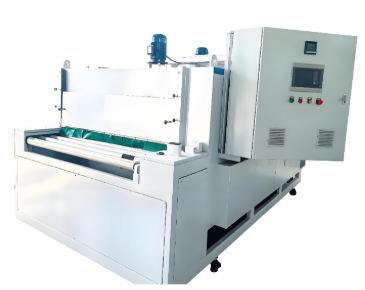
ROSS zigzag tester



The Sole Flexing Resistance Tester is designed to evaluate the resistance of shoe sole materials to cracking and cut growth during repeated bending. The specimen is mounted on the testing machine and repeatedly flexed through 90° around a specified shaft. After a defined number of cycles, the cut length is measured to assess the material's flexing resistance.
The tester supports simultaneous testing of up to 12 specimens and features adjustable rotation speed and automatic stopping when the preset test duration is reached. It is suitable for footwear manufacturers, rubber and polymer material producers, and quality control laboratories evaluating sole durability.
Application
(1) Rubber sole materials
(2) Polyurethane (PU) sole materials
(3) PVC and thermoplastic rubber (TR) soles
(4) EVA and other polymeric sole materials
(5) Shoe sole strips and molded sole specimens
(6) Footwear material research and development
(7) Sole cracking resistance and cut growth evaluation
(8) Footwear quality control and durability testing
Standards
(1) ASTM D1052-09(2026) — Standard Test Method for Measuring Rubber Deterioration—Cut Growth During Repeated Flexing
(2) ISO 5423:1992 — Moulded Plastics Footwear — Lined or Unlined Polyurethane Boots for General Industrial Use — Specification
(3) SATRA TM60 — Resistance to Cut Growth on Flexing
(4) HG/T 2411-2006 — Test Method for 90° Flexing of Sole Material
Parameters
| Parameter | Specification |
|---|---|
| Simultaneous Test Capacity | 12 specimens |
| Bending Angle | 90° ± 2° |
| Rotation Speed | 0–100 rpm, adjustable |
| Controller | LED-SLD806 integrated display controller |
| Punch Diameter | 2.5 mm |
| Test Mode | Automatic stop when the preset test duration is reached |
| Flexing Shaft Diameter | 10 mm |
| Specimen Size | 152 × 25 mm |
| Power Supply | AC 220 V, 10 A |
Features
(1) Tests up to 12 specimens simultaneously.
(2) Adjustable rotation speed from 0 to 100 rpm.
(3) Provides a bending angle of 90° ± 2°.
(4) Automatically stops when the preset test duration is reached.
(5) Uses a 10 mm diameter flexing shaft.
(6) Evaluates cut growth after repeated bending.
Accessories
(1) Main testing unit × 1
(2) Cutting die × 1
(3) Power cable × 1
(4) Cutting knife × 1
(5) Instruction manual × 1
Maintenance Information
(1) Inspect the flexing shaft and specimen fixtures for wear or damage.
(2) Keep the clamping components clean and secure.
(3) Check the rotation mechanism for abnormal noise or vibration.
(4) Verify the rotation speed and bending angle periodically.
(5) Inspect the cutting die and knife to ensure consistent specimen preparation.
(6) Clean the machine after testing and remove accumulated material debris.
(7) Follow the manufacturer's instructions for routine maintenance and servicing.


Leave Message Get Price